Learning Styles and Motivation in the ESL/EFL Classroom.
VARK Model


Visual learners primarily rely on their sense of sight to understand and retain information. They have a strong preference for visual aids, graphics, and other forms of visual representation. Here's more about visual learners:
- Characteristics: Visual learners are often skilled at recognizing patterns, colors, and shapes. They may have a good spatial understanding and can easily remember the visual layout of diagrams and charts. They tend to be detail-oriented and appreciate visual aesthetics.
- Preferred Learning Materials: Visual learners gravitate toward materials like diagrams, charts, infographics, photographs, slideshows, videos, and illustrations. These visual elements help them absorb complex information more easily.
- Study Strategies: Effective study strategies for visual learners include creating colorful mind maps to connect ideas, using flashcards with images to reinforce memorization, and watching educational videos that provide visual demonstrations.

- Characteristics: Auditory learners are typically excellent listeners. They have a strong ability to remember spoken information and may excel in oral communication. They often appreciate music and have a good ear for sounds and rhythms.
- Preferred Learning Materials: Auditory learners prefer lectures, discussions, podcasts, audiobooks, and recorded presentations. These materials enable them to absorb and retain information through listening.
- Study Strategies: Effective study strategies for auditory learners include participating in group discussions to reinforce key concepts, reading learning materials aloud to themselves, and recording important lectures or class sessions for later review.

- Characteristics: Kinesthetic learners have a strong need for physical movement and hands-on experiences. They tend to have excellent motor skills and coordination. They learn best through action and often have a strong sense of touch and bodily awareness.
- Preferred Learning Materials: Kinesthetic learners favor practical activities, hands-on experiments, role-playing, and real-world applications of knowledge. They require interactive learning experiences to grasp and internalize concepts.
- Study Strategies: Effective study strategies for kinesthetic learners involve engaging in physical activities related to the subject matter, conducting experiments to understand scientific principles, and participating in role-playing scenarios that simulate real-world situations.

Reading and writing learners find comfort in written materials and excel at processing information through the written word. These learners may present themselves as copious note-takers or avid readers and can translate abstract concepts into words and essays. Here's a more in-depth look at this learning style:
- Characteristics: Reading and writing learners often have a strong aptitude for reading and writing. They enjoy reading books, articles, and written documents and are adept at taking notes, summarizing information in written form, and expressing themselves through writing.
- Preferred Learning Materials: These learners thrive on textbooks, written notes, articles, and written assignments. They may prefer reading materials in print or digital format to acquire knowledge.
- Study Strategies: Effective study strategies for reading and writing learners include creating comprehensive outlines and written summaries of material, taking detailed notes during lectures, and rewriting information in their own words to reinforce understanding.

Now as we mentioned before there is more than one model of learning styles, Let's talk about another one, shall we?
David A. Kolb's Experiential Learning Model is a comprehensive framework that describes the learning process as a cycle consisting of four stages, each representing a different aspect of the learning journey. Kolb's model suggests that effective learning involves a continuous progression through these stages.
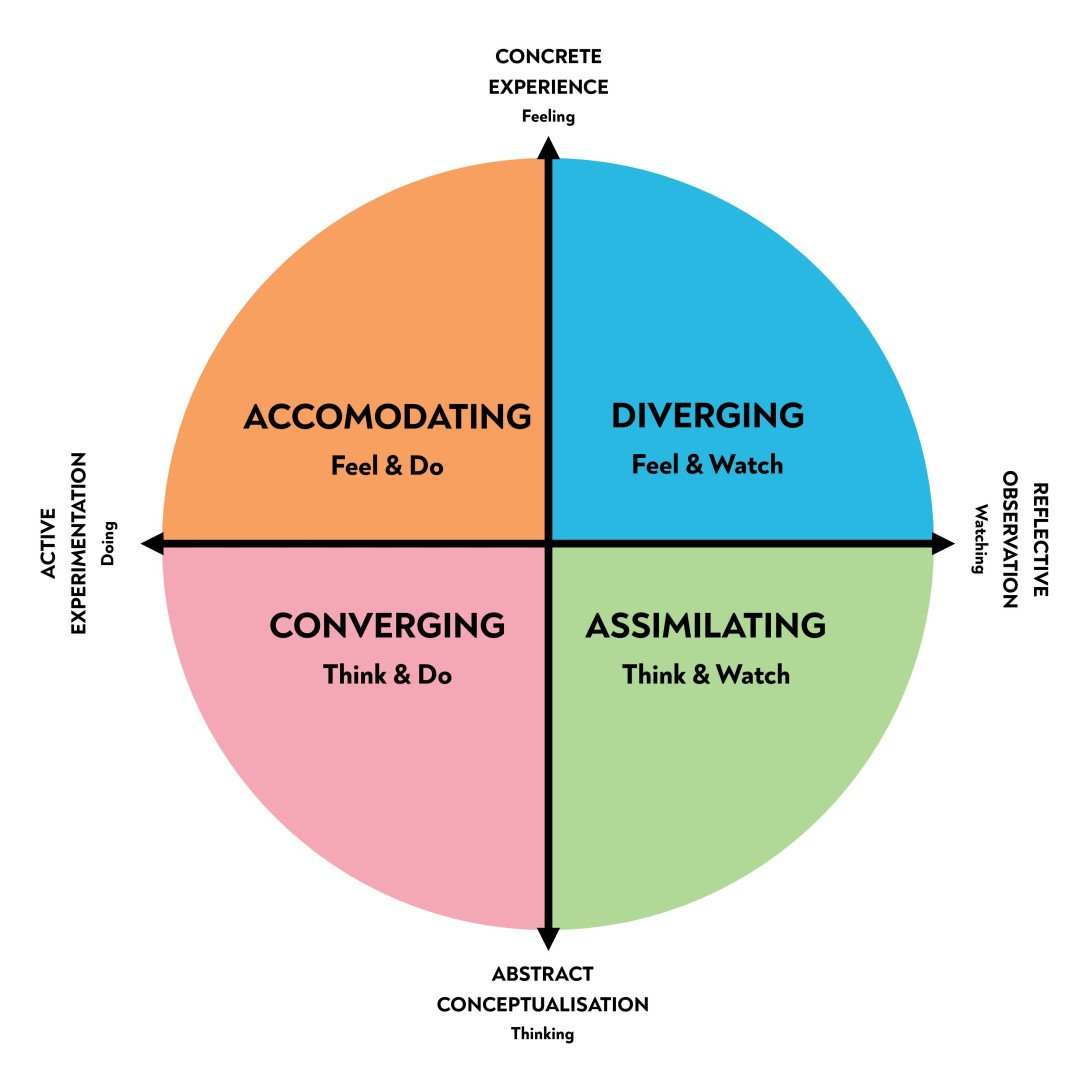
Here's a closer look at each of the stages and the characteristics associated with them:
-
Concrete Experience (CE)
- Characteristics: In this initial stage, learners engage in hands-on experiences and direct interactions with the subject matter. They rely on their senses and emotions to gather information and form perceptions.
- Preferences: Individuals who favor the concrete experience stage are often action-oriented, adventurous, and open to new experiences. They enjoy trying things out and participating actively in learning activities. They may value real-life examples and practical applications.
-
Reflective Observation (RO)
- Characteristics: In this stage, learners take a step back to contemplate and review their experiences. They seek to understand and make sense of what they've encountered, looking for patterns and connections.
- Preferences: Reflective observers are introspective and analytical. They appreciate opportunities for thoughtful discussion, self-assessment, and peer feedback. They enjoy reviewing their experiences and often value feedback and diverse viewpoints.
-
Abstract Conceptualization (AC)
- Characteristics: During this stage, learners use reflective observations to form abstract concepts and theories. They seek to create generalizations and principles based on their experiences.
- Preferences: Individuals who prefer abstract conceptualization are typically logical and analytical thinkers. They thrive when they can engage in structured discussions, concept mapping, and theoretical explorations. They value clarity, logical reasoning, and a systematic approach to learning.
-
Active Experimentation (AE)
- Characteristics: In the final stage of the cycle, learners test their theories and concepts through practical applications. They aim to put their newfound knowledge into action and engage in problem-solving.
- Preferences: Active experimenters are action-oriented and practical. They excel in situations where they can apply their knowledge to real-world scenarios, conduct hands-on experiments, and engage in active problem-solving. They value the opportunity to test their ideas and theories in practical contexts.
Kolb's model suggests that effective learning is not confined to any single stage but involves a continuous and dynamic process of moving through all four stages. Learners may have a preferred stage within this cycle, but they benefit from experiencing all stages to achieve a more comprehensive and well-rounded understanding.
Honey and Mumford's Learning Styles
Honey and Mumford's model is an adaptation of Kolb's Experiential Learning Model and classifies learners into four distinct styles, each characterized by specific traits, preferences, and approaches to learning. These styles provide valuable insights into how individuals prefer to engage with the learning process. Here's a deeper look at each of these styles.
Activists
-
- Characteristics: Activists are enthusiastic and outgoing learners who embrace new experiences with open arms. They often learn through trial and error, enjoying hands-on activities and challenges. They are spontaneous and willing to jump into tasks without too much forethought.
- Preferences: Activists prefer active and experiential learning. They enjoy group work, role-playing, simulations, and real-world experiences. They appreciate variety and opportunities for problem-solving and exploration. However, they may struggle with maintaining focus in longer, more structured situations.
Reflectors
-
- Characteristics: Reflectors are thoughtful and contemplative learners who value careful observation and analysis. They take their time to consider situations, often seeking multiple perspectives before taking action. They are patient and enjoy a structured approach to learning.
- Preferences: Reflectors thrive in activities that allow for reflection, such as case studies, group discussions, journaling, and quiet self-assessment. They are skilled at reviewing past experiences, seeking patterns, and considering various viewpoints. However, they may find overly active or rushed learning environments less comfortable.
Theorists
-
- Characteristics: Theorists approach learning with a systematic and logical mindset. They are analytical and prefer to understand the underlying principles and theories behind concepts. They value clarity and structure in their learning materials.
- Preferences: Theorists appreciate learning experiences that provide clear explanations, logical reasoning, and concept mapping. They excel in situations where they can create models, theories, or frameworks to make sense of information. They may find ambiguity and unstructured content challenging.

Pragmatists
- Characteristics: Pragmatists are practical and action-oriented learners who seek immediate applications of knowledge. They are motivated by learning that has direct relevance and usefulness in real-life situations. They value problem-solving and hands-on experiences.
- Preferences: Pragmatists enjoy activities that have real-world significance, such as practical exercises, simulations, and problem-solving challenges. They thrive when they can apply theory to practice. They may find purely theoretical or abstract content less engaging.
|
Aspect |
VARK
Model |
Honey
and Mumford's Learning Styles |
Kolb's
Experiential Learning Model |
|
Number
of Styles |
Four:
Visual, Auditory, Reading/Writing, Kinesthetic |
Four:
Activist, Reflector, Theorist, Pragmatist |
Four
stages within a learning cycle |
|
Primary
Focus |
Sensory preferences for
receiving information |
Learning preferences and
approaches |
Phases of the learning process |
|
Characteristics
of Styles |
-
Visual: Prefers visual aids and diagrams - Auditory: Learns best through listening -
Reading/Writing: Excels in written materials -
Kinesthetic: Learns by doing and manipulating |
-
Activists: Eager for new experiences, hands-on -
Reflectors: Thoughtful and contemplative -
Theorists: Systematic and logical thinkers -
Pragmatists: Practical, focused on real-world applications |
-
Concrete Experience: Hands-on, experiential learning -
Reflective Observation: Thoughtful analysis -
Abstract Conceptualization: Theoretical understanding - Active Experimentation: Practical
application |
|
Preferences
in Learning Materials |
Visual aids, auditory materials,
written content, hands-on experiences |
Varied learning materials based
on their style (e.g., hands-on, reflective, theoretical, practical) |
Varied materials in different
stages, including real-world examples, discussions, theoretical readings, and
practical applications |
|
Flexibility
and Adaptability |
Recognizes
the possibility of a combination of styles and adaptability |
Encourages
flexibility but focuses on dominant style |
Emphasizes
a dynamic cycle where learners move through all stages |
|
Educational
Application |
Tailoring teaching methods to
match students' primary styles |
Adapting teaching strategies to
accommodate diverse learning styles |
Incorporating elements from each
stage into teaching to engage a range of learners |

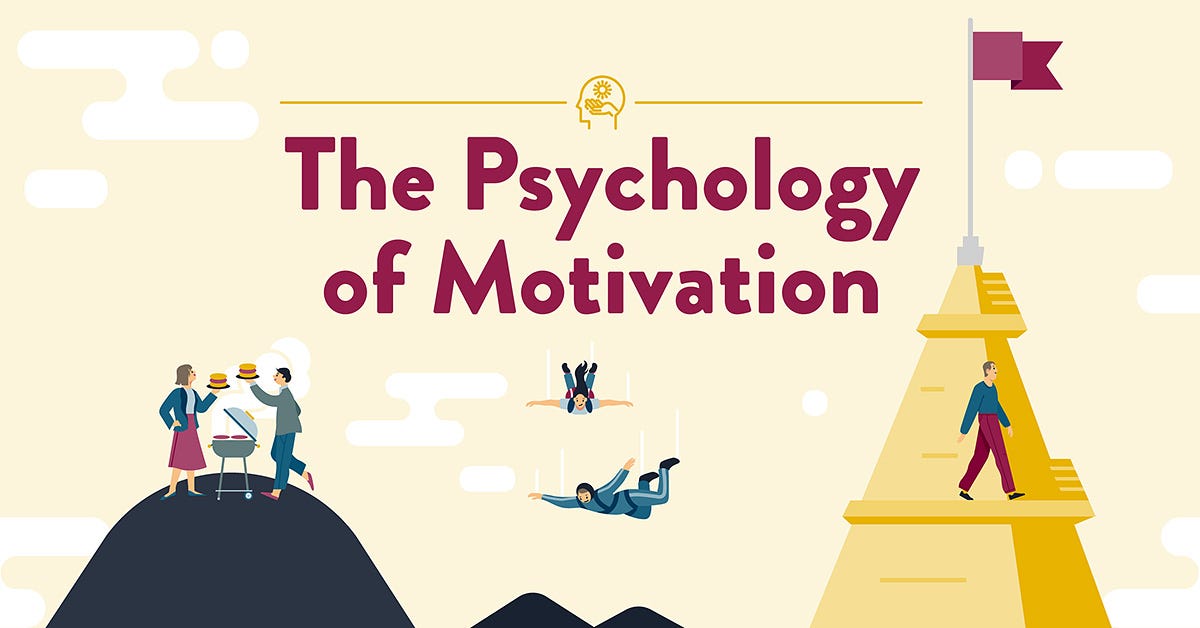


What are the types of motivation?
The two main types of motivation are frequently described as being either extrinsic or intrinsic.
- Extrinsic motivation arises from outside of the individual and often involves external rewards such as trophies, money, social recognition, or praise.
- Intrinsic motivation is internal and arises from within the individual, such as doing a complicated crossword puzzle purely for the gratification of solving a problem.

Why motivation is important
Motivation serves as a guiding force for all human behavior. So, understanding how motivation works and the factors that may impact it can be important for several reasons.
Understanding motivation can:
- Increase your efficiency as you work toward your goals.
- Drive you to take action.
- Encourage you to engage in health-oriented behaviors.
- Help you avoid unhealthy or maladaptive behaviors, such as risk-taking and addiction.
- Help you feel more in control of your life.
- Improve your overall well-being and happiness.
- AsapSCIENCE. (2016, January 7). The Science Of Motivation [Video]. YouTube. https://www.youtube.com/watch?v=pZT-FZqfxZA
- · BetterHelp Editorial Team. (2023, October 26). How do psychologists define motivation? | BetterHelp. https://www.betterhelp.com/advice/psychologists/how-do-psychologists-define-motivation/
- · Cofer, C. N., & Petri, H. L. (2023, October 20). Motivation | Definition, Examples, Psychology, Types, & Facts. Encyclopedia Britannica. https://www.britannica.com/topic/motivation
- · Denis. (2022, November 23). Honey and Mumford learning styles explained. expert. https://expertprogrammanagement.com/2020/10/honey-and-mumford/ Department of Health | Identifying your personal learning style. (n.d.). https://www1.health.gov.au/internet/publications/publishing.nsf/Content/drugtreat-pubs-front1-wk-toc~drugtreat-pubs-front1-wk-secb~drugtreat-pubs-front1-wk-secb-2~drugtreat-pubs-front1-wk-secb-2-5~drugtreat-pubs-front1-wk-secb-2-5-ide#:~:text=The%20four%20different%20ways%20in,one%20moves%20through%20over%20time. Engage, & Engage. (2023, March 28). VAK learning styles: what are they and what do they mean? Engage Education |. Engage Education. https://engage-education.com/aus/blog/vak-learning-styles-what-are-they-and-what-do-they-mean-engage-education/ MindTools | Home. (n.d.). https://www.mindtools.com/ak6cyjn/vak-learning-styles#:~:text=VAK%20stands%20for%20visual%2C%20auditory,physical%2C%20hands%2Don%20approach.
- · Hawthorne, H. (2023, October 3). Understanding the importance of motivation in education. The Hub | High Speed Training. https://www.highspeedtraining.co.uk/hub/motivation-in-education/
- · Intrinsic and Extrinsic Motivation: difference & best practices. (2023, February 13). Personio. https://www.personio.com/hr-lexicon/intrinsic-and-extrinsic-motivation/
- · Motivation | Definition, Examples, Psychology, Types, & Facts. (2023, October 20). Encyclopedia Britannica. https://www.britannica.com/topic/motivation/Behavioristic-approaches-to-motivation
- · MSEd, K. C. (2022, May 23). Extrinsic vs. Intrinsic Motivation: What's the Difference? Verywell Mind. https://www.verywellmind.com/differences-between-extrinsic-and-intrinsic-motivation-2795384
- · Msiop, A. D. L. C. O. S. M. M. (2021, February 6). Humanistic Theory of Motivation (Maslow’s Hierarchy of Needs). https://www.linkedin.com/pulse/humanistic-theory-motivation-maslows-hierarchy-needs
- · Tarver, E. (2022, May 2). 11 Types of Motivation: What They Are & How to Use Them 2020. evantarver.com. https://evantarver.com/types-of-motivation/
- · Wikipedia contributors. (2023, November 4). Motivation. Wikipedia. https://en.wikipedia.org/wiki/Motivation
Comentarios
Publicar un comentario